The evidence layer is append-only publisher material. The consumption layer is reproducible and disposable. That split lets an extraction improve without rewriting what the publisher served.
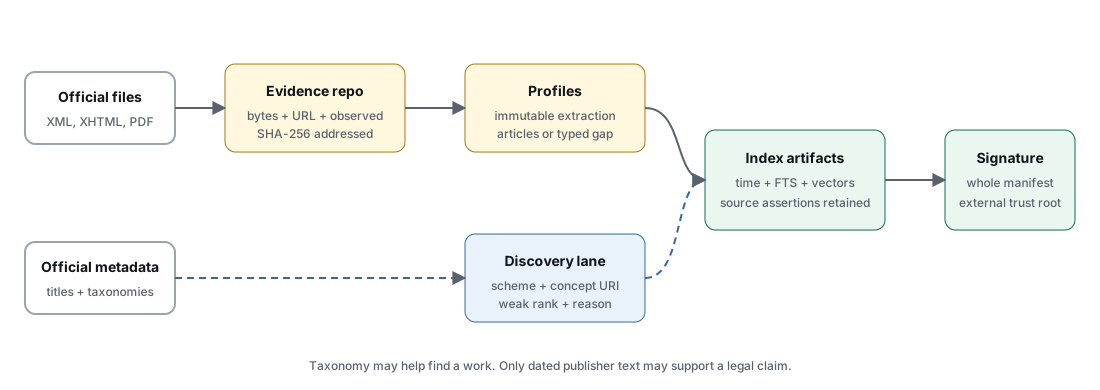
Open the data authority diagram at full size
Ingestion and derivation
| Stage | Input | Output | Owner | Refusal boundary |
|---|---|---|---|---|
| Enumerate | Official publisher catalogue | Works, states, expressions and manifestations | Lex.Sources.Legilux or Lex.Sources.EurLex |
A partial or implausible inventory commits nothing |
| Acquire | Official URLs | Verbatim bytes and observation records | publisher adapter plus evidence repository | Existing evidence is not silently overwritten |
| Derive | Stored bytes plus immutable extraction profile | Article records and typed gaps | Lex.Derive |
Unsafe structure remains unavailable |
| Index | Hash-pinned corpora and article release | SQLite FTS, temporal tables and optional vectors | Lex.Ingest and Lex.Index on the local build machine |
Incomplete or mismatched inputs fail the build |
| Sign | Canonical artifact manifest | Signature and public verification material | bounded lex-ops publication with Key Vault |
Runtime rejects a manifest outside pinned trust |
Official discovery metadata
Luxembourg acquisition mirrors Legilux subjectLevel1 and subjectLevel2 assertions with the
concept URI, French label, level, language and source. EU acquisition mirrors official short-title
segments, EuroVoc assigned, alternative and broader relations, and directory classifications with
their identifiers and source URIs. The two vocabulary systems remain distinct.
These values enter a weak, explainable discovery lane. They may surface a work whose provisions do not contain the query phrase and the result can say which official classification matched. They do not establish legal identity, support a legal claim or become historical evidence. No manual legal alias catalogue and no model-generated metadata enter production authority.
What the cryptography proves
| Mechanism | Proves | Does not prove |
|---|---|---|
| SHA-256 of a file or provision | The bytes read now equal the bytes previously addressed by that digest | Who published the bytes or whether the law is valid |
| Publisher URL and observation record | Where and when Lex acquired the material | That a later copy was not modified |
| Signed whole-artifact manifest | A controlled release identity approved this exact set of indexes, vectors, encoder and scope files | Legal correctness by itself |
| Signed evaluation and promotion receipts | The exact candidate passed the stated gates and became the named revision | Future behavior under every possible question |
Origin, integrity and release authorization are separate claims. Keeping all three is why a citation can be checked without treating a hash as a magical certificate of truth.